Call us
(505) 420-6002
Yes, microcement can be used outdoors in New Mexico, but the specific microcement system, substrate preparation, drainage, texture, and protective finish all matter. Exterior microcement systems can create seamless decorative surfaces for patios, courtyards, outdoor kitchens, walls, steps, and other areas without the grout lines associated with tile or pavers.
New Mexico, however, isn't an environment where you should simply take an interior microcement system and put it outside.
Outdoor surfaces in Albuquerque and Santa Fe can experience intense sunlight, hot summer temperatures, freezing winter nights, rapid temperature changes, windblown dirt, and occasional heavy rain. Albuquerque also has documented freezing conditions during its colder months, with average spring freeze dates ranging from early to late April depending on location within the metro area.
That makes product selection and installation especially important.
If you're considering outdoor microcement in NM, this guide explains where it can be used, how it performs, what affects microcement patio durability, and what New Mexico homeowners should know before choosing it for an exterior project.
Outdoor microcement is a thin decorative cementitious finish designed to create a continuous surface over a properly prepared substrate.
Rather than pouring a thick new concrete slab, a microcement system is installed in thin layers over an existing or newly constructed stable surface.
Depending on the product system, the components can include:
The exact system varies by manufacturer and application.
The finished surface can resemble concrete, stone, plaster, or another hand-troweled mineral finish while remaining much thinner than conventional concrete.
One of its biggest design advantages is continuity. Instead of visually breaking a patio into individual tiles or pavers, microcement can produce a broad, flowing surface.
Some manufacturers specifically formulate microcement systems for exterior exposure. For example, decco lists systems intended for both interior and exterior applications and offers UV-resistant products for outdoor use.
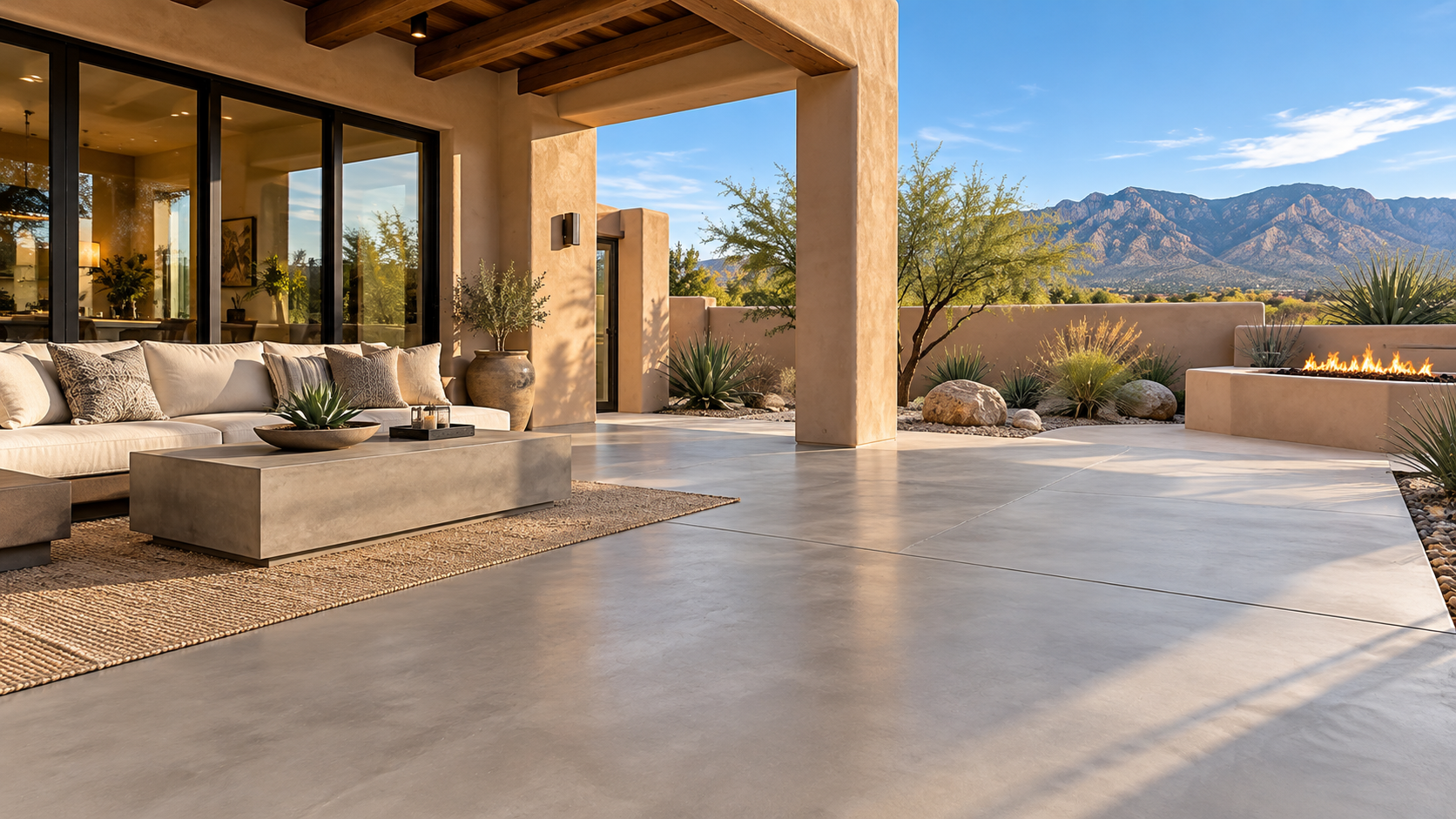
Yes, but only a system designed for exterior conditions should be used outdoors.
This distinction is important.
"Microcement" describes a category of decorative finishes rather than one universal product. Different formulations, primers, reinforcement systems, sealers, and topcoats have different performance characteristics.
An exterior installation may need to withstand:
Some exterior microcement products are specifically formulated for UV and water resistance.
Homeowners should therefore ask their contractor which complete system is being proposed and whether its manufacturer approves that system for the intended exterior application.
New Mexico's climate creates a combination of conditions that exterior decorative surfaces need to handle.
Outdoor surfaces around Albuquerque and Santa Fe receive substantial direct sunlight.
Albuquerque's historical June record high is 107°F, and the city reached 100°F during June 2026.
Remember that air temperature and surface temperature aren't the same thing. A patio exposed to direct summer sun can become considerably hotter than the surrounding air.
That makes UV stability particularly important for exterior decorative finishes.
New Mexico is dry, but it isn't warm year-round.
Albuquerque and surrounding communities experience freezes, with timing varying significantly by elevation and neighborhood. National Weather Service climate data, for example, lists the average last 32°F spring freeze around April 6 at the Albuquerque Sunport, April 18 in the South Valley, April 21 in the Foothills, and April 25 in Corrales.
Northern and higher-elevation areas can face colder conditions.
New Mexico receives relatively little precipitation compared with many parts of the country. Albuquerque recorded 6.71 inches of precipitation in 2025, which was 2.13 inches below the 1991-2020 normal for that year.
Low annual rainfall, however, doesn't eliminate the need for good drainage.
A single storm can still put substantial water on a patio. Water that becomes trapped where it shouldn't be can create problems regardless of the region's annual rainfall.
Fine dirt and grit are a normal part of outdoor living in New Mexico.
Those particles can become abrasive under shoes, patio furniture, and other objects. Exterior surfaces should therefore be selected and maintained with abrasion in mind.
The easiest way to understand microcement patio durability is to look at the major environmental stresses individually.
The important takeaway is that microcement durability isn't determined by microcement alone.
The entire assembly matters.
One of microcement's strongest advantages is versatility.
Depending on the system and substrate, exterior applications can include several areas around the home.
Yes. Patios are one of the most attractive potential applications for exterior microcement.
A microcement patio can create a seamless contemporary surface that complements stucco, wood, steel, stone, and Southwestern architecture.
It can work especially well around modern Albuquerque homes where homeowners want the visual simplicity of concrete without necessarily pouring an entirely new decorative slab.
Yes. Certain microcement and quartz-enhanced decorative systems are designed for pool decks and other outdoor wet areas. These surfaces can combine the seamless, modern appearance of microcement with added resistance to abrasion, impact, chemicals, and everyday outdoor wear. Texture can also be incorporated into the finish to improve traction around wet areas, which is an important consideration for any pool deck. For New Mexico homes, a properly specified exterior system can provide a durable, attractive alternative to traditional concrete, tile, or other pool-deck finishes while complementing modern and Southwestern outdoor spaces.
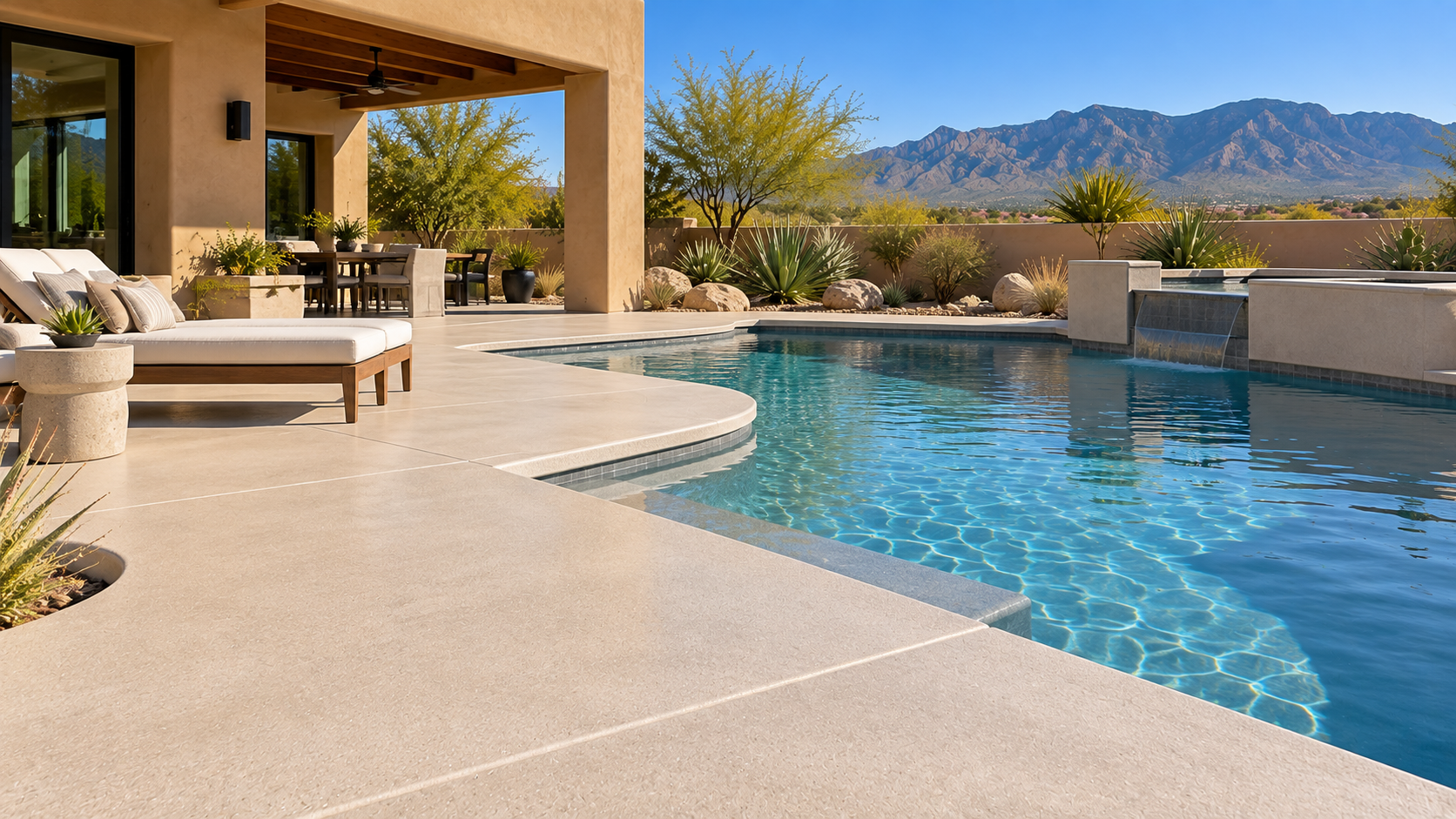
Yes.
Courtyards are particularly well suited to the appearance of microcement.
New Mexico architecture frequently uses enclosed and semi-enclosed outdoor living spaces. A continuous cementitious finish can complement adobe-inspired walls, vigas, natural wood, fireplaces, and xeriscaping.
Colors can also be selected to coordinate with earth-tone architecture.
Depending on the approved product system, microcement can be used to create a cohesive finish around outdoor kitchen elements.
Potential applications include:
Outdoor kitchens experience grease, food, moisture, heat, and frequent cleaning, so the selected finish needs to be appropriate for the specific surface and exposure.
Exterior walls can be another excellent application.
Because vertical surfaces don't experience the same foot traffic as patios, they present different performance demands.
Microcement can provide a modern mineral appearance on architectural features, accent walls, outdoor kitchens, and protected exterior living spaces.
The handcrafted texture works particularly well alongside stucco and other Southwestern materials.
Potentially, yes, but steps require careful planning.
Slip resistance, edge detailing, substrate stability, and wear all become important.
A finish that works beautifully on a decorative wall isn't automatically appropriate for exterior stairs.
Always discuss the intended application with the installer before selecting the final texture and coating system.
This question requires some nuance.
Some microcement systems are specifically manufactured and marketed as waterproof or highly water-resistant, including products approved for exterior terraces.
However, homeowners shouldn't interpret that to mean a decorative microcement finish can fix an underlying drainage or waterproofing problem.
Those are separate issues.
A properly designed patio still needs appropriate:
If water pools on the existing patio, covering the problem with a decorative finish doesn't solve the underlying geometry.
Water should move away from the home and off the finished surface as intended.
Poor drainage can cause water to remain on a patio or penetrate vulnerable areas in the overall assembly.
In a climate where freezing temperatures occur, moisture management becomes even more important.
Before applying microcement, the contractor should evaluate whether the existing surface has appropriate drainage and whether repairs are necessary.
This is one reason substrate evaluation should happen before color and texture selection.
A beautiful finish can't compensate for a poorly designed base.
Microcement can develop cracks if the underlying substrate moves or if the system is improperly installed.
This is true of many rigid or semi-rigid decorative finishes.
Microcement is thin. It doesn't transform an unstable slab into a stable one.
Existing concrete should be evaluated for:
Existing cracks may require treatment before the decorative system is installed.
It's also important to understand that no surface treatment can guarantee an actively moving concrete slab will never telegraph movement into the finish.
Often, yes, and this can be one of its biggest remodeling advantages.
If an existing concrete patio is structurally suitable, microcement may provide a way to dramatically change its appearance without demolishing the entire slab.
However, the concrete needs to be evaluated first.
A good candidate is very different from a slab that is severely settling, breaking apart, or moving.
Preparation may include cleaning, mechanical preparation, repairs, primers, reinforcement, and other steps required by the particular system.
Skipping preparation to save money is rarely a good tradeoff.
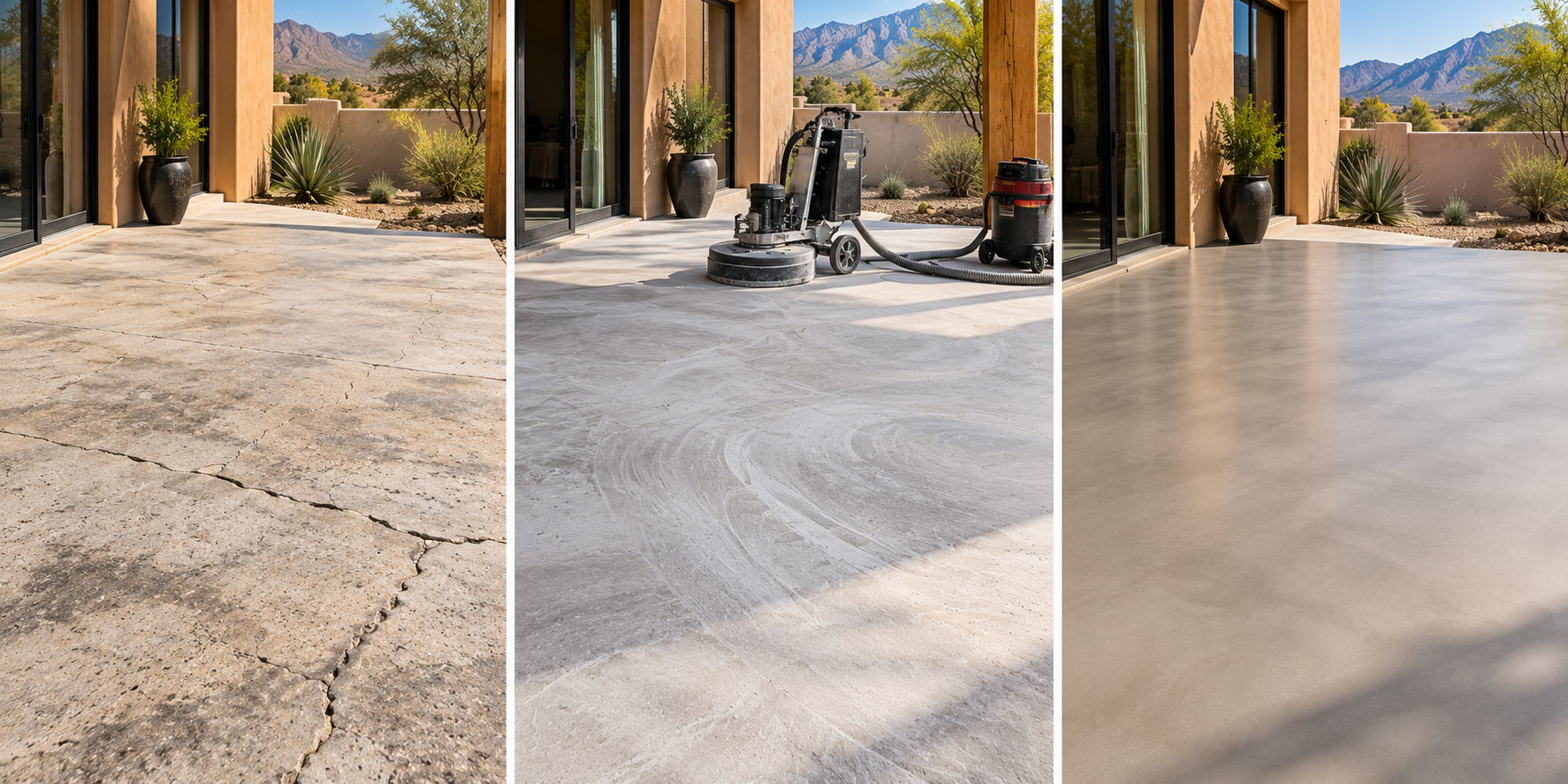
It can be if the wrong finish is selected.
Outdoor walking surfaces should be designed with traction in mind.
A highly smooth decorative surface that looks beautiful inside a living room may not be appropriate beside a wet outdoor area.
Texture and finish can be adjusted depending on the system to provide greater slip resistance.
This is particularly important for:
Tell your contractor how the area will actually be used rather than selecting the finish based only on a sample's appearance.
This depends heavily on the system.
Exterior applications should use pigments, finishes, and sealers intended for UV exposure.
Some exterior microcement manufacturers specifically advertise UV-resistant systems designed to maintain their characteristics outdoors.
This is particularly relevant in New Mexico because exterior surfaces can spend hours in direct, intense sunlight.
Ask whether the proposed product is manufacturer-approved for exterior UV exposure.
Don't assume an interior system will perform the same way outside.
This is where microcement becomes especially interesting from a design standpoint.
Colors that complement New Mexico architecture include:
Lighter colors can also be practical for uncovered patios because dark surfaces tend to absorb more solar energy.
The ideal color depends on the architecture surrounding the space.
For example, a warm sand finish can complement an adobe-style Santa Fe home, while a light gray microcement patio may fit a contemporary Albuquerque home with black steel, glass, and natural wood.
Traditional concrete and microcement may look similar, but they're fundamentally different systems.
Concrete is structural and is typically poured several inches thick.
It can form the actual patio slab.
Microcement is a thin decorative finish installed over an appropriate substrate.
It isn't a replacement for the structural slab beneath it.
This distinction matters when homeowners are deciding whether to resurface an existing patio or construct an entirely new one.
If you already have a suitable concrete patio and want a dramatically different appearance, microcement may be worth exploring.
If you don't have a patio at all, you still need an appropriate structural base.
Both have advantages.
Microcement is particularly appealing when homeowners want a monolithic appearance rather than a visibly tiled surface.
Pavers create a completely different aesthetic.
They work well when homeowners want:
Microcement is better suited to homeowners seeking:
Neither is universally better. They solve different design problems.
Outdoor microcement should be treated as a finished architectural surface rather than something that can be ignored indefinitely.
Routine maintenance may include:
New Mexico's windblown grit deserves particular attention.
Sand underneath patio furniture can act like sandpaper when chairs or tables are dragged across the surface.
Regular cleaning helps minimize unnecessary abrasion.
There isn't one honest lifespan that applies to every microcement patio.
Longevity depends on the complete system and conditions, including:
A professionally specified exterior system installed over a sound substrate will have a much better chance of long-term performance than an interior-grade product placed over deteriorating concrete.
When comparing contractors, ask about the entire installation process rather than simply asking how many years "microcement" lasts.
Seamless appearance: Microcement creates broad, continuous surfaces without traditional tile grout lines.
Design flexibility: Colors and textures can be customized to complement Southwestern and contemporary architecture.
Thin profile: It can often transform an existing suitable surface without adding the thickness associated with another concrete pour.
Versatility: Depending on the system, it can be used on floors, walls, steps, outdoor kitchens, and other architectural elements.
Modern appearance: Few materials create the same handcrafted, minimalist aesthetic.
Installation matters greatly: This isn't a finish where poor preparation can easily be hidden.
The substrate must be suitable: Serious movement or deterioration should be corrected first.
Maintenance is still required: Exterior protective finishes may eventually need renewal.
Product selection matters: Not every microcement system is intended for outdoor UV, water, and weather exposure.
Cost can exceed basic resurfacing: You're paying for a specialized, hand-applied architectural finish.
It can be an excellent choice when the project and homeowner are a good match.
Consider exterior microcement if you want:
New Mexico is also a particularly interesting market for the material because microcement's natural mineral appearance complements the region's architectural vocabulary.
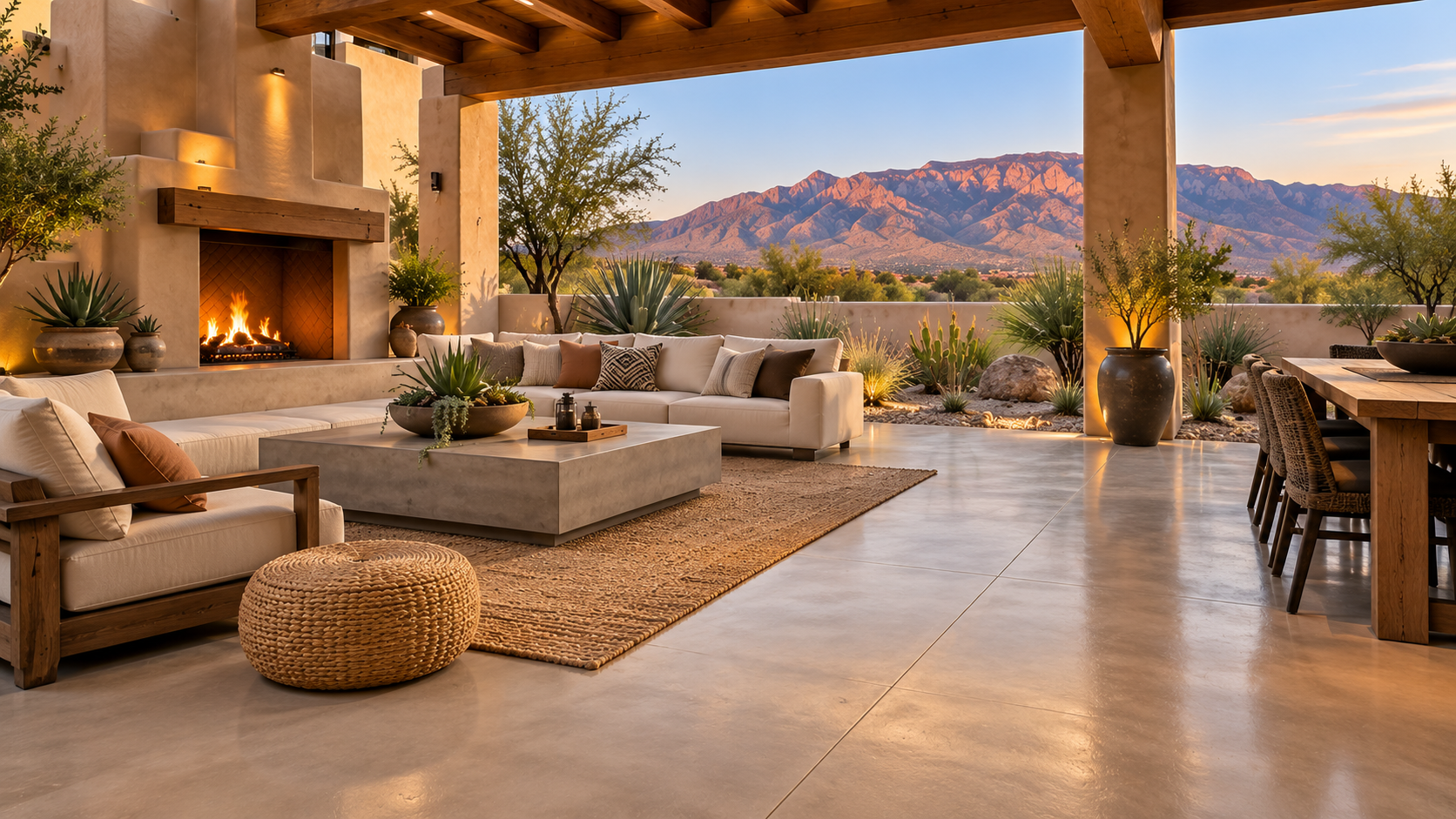
Adobe-inspired walls, wood vigas, steel details, desert landscaping, natural stone, and microcement can work together without competing visually.
Before hiring someone, ask specific questions rather than simply asking whether they "do microcement."
Important questions include:
A qualified installer should be comfortable discussing these issues.
Yes. Outdoor microcement can be a beautiful option for New Mexico patios, courtyards, exterior walls, outdoor kitchens, and other spaces when an appropriate exterior system is installed over a properly prepared and stable substrate.
The key phrase is appropriate exterior system.
New Mexico's combination of strong sunshine, summer heat, winter freezes, dust, and rapid weather changes makes shortcuts a poor idea. UV resistance, water management, substrate preparation, traction, and protective coatings should all be considered before installation. Albuquerque's documented summer heat and seasonal freezes reinforce why exterior material selection matters.
When those details are handled correctly, microcement offers something few outdoor finishes can match: a seamless, handcrafted surface that feels both modern and naturally suited to Southwestern architecture.
If you're considering outdoor microcement in Albuquerque, Santa Fe, or the surrounding areas, High Desert Concrete Design can help you determine whether your patio or outdoor living space is a good candidate.
Our team specializes in decorative concrete finishes designed to transform ordinary surfaces into distinctive architectural features. We can evaluate your existing surface, discuss color and texture options, and help you choose a finish suited to your home's design and the demands of New Mexico's climate.
Contact High Desert Concrete Design to discuss your outdoor microcement project and request more information.
If you want to learn more about our services and floors or request a FREE estimate, you can contact us on one of the below methods.


.png)
High Desert Concrete Design Albuquerque, an XPS trained and certified installer, offers premium epoxy flooring solutions for commercial, residential, and industrial properties at budget-friendly prices.